Thursday, 15 May 2014

Jhola! Buen Camino

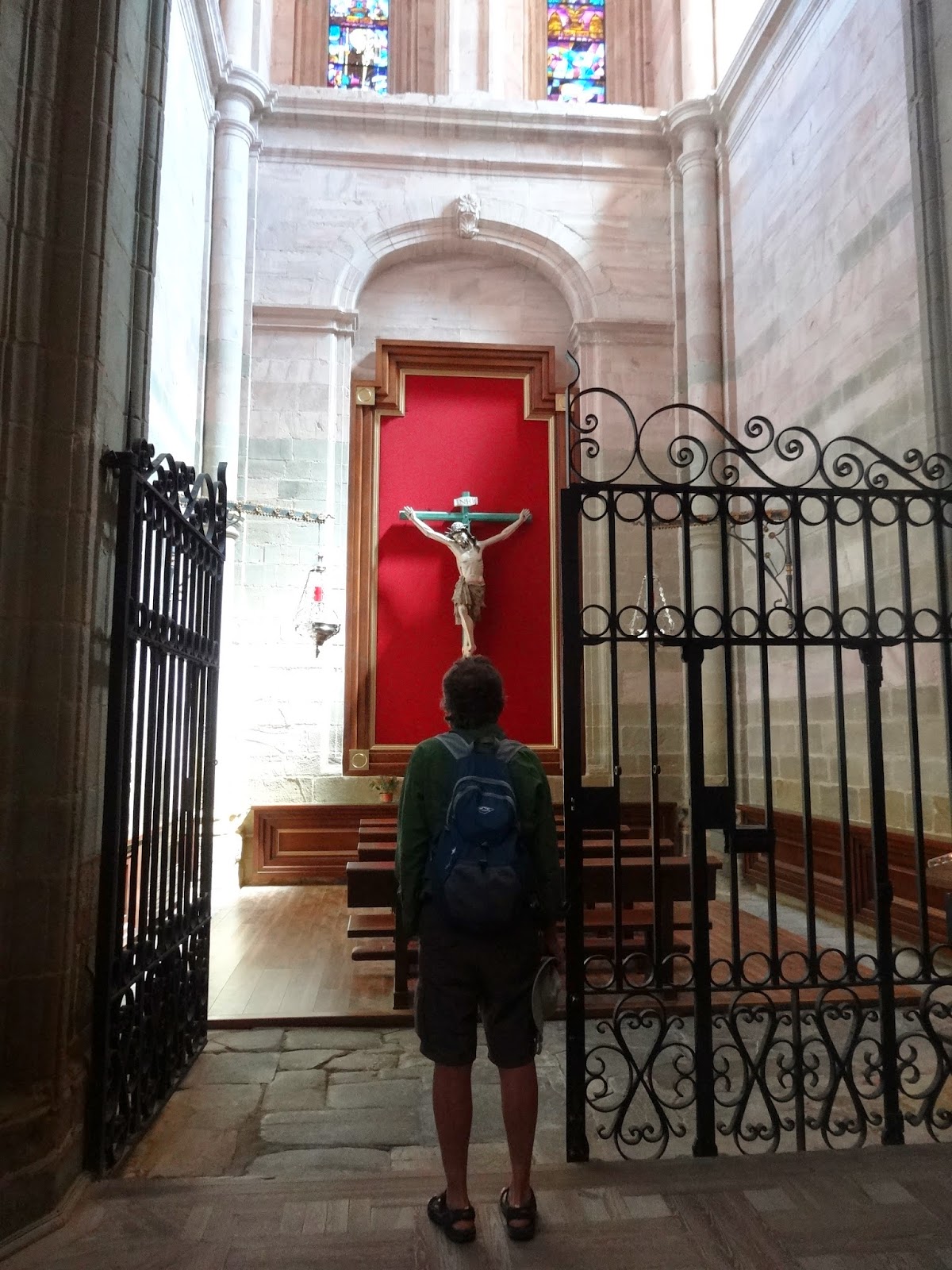
Jhola, buen Camino!  Hello, good Camino, we have said those words a hundred times today as we pass perigrinos and they pass us.  The Camino is becomming busier the closer we get to Santiago.  People of many nationalities are walking and now there are many Spanish who do sections of the walk each year.

We have started to book our hotel accommodation two nights in advance due to the high number of walkers and the limited accommodation available in the small towns. For this we use a variety of means.  First we attempt to book a room ourselves by mobile phone or Skype, and occasionally we are successful. Sometimes the mobile phone does not have access so we revert to Skype.  Sometimes when we finally get through to the required hotel, no-one speaks English.  Even with our limited Spanish of days and dates it becomes impossible. We then revert to the goodness of the management of the hotel we are staying in to phone for us and book the room for the next day.  Often they speak very little English as well so we are never really certain if the booking has actually been made, although it has always worked out up to now. The Spanish people have been wonderfully hospital for the most part, so we just have blind faith and it has all worked out fine so far.

We've had two days of really great walking.  The first day out of Hospital de Orbigo was through woodlands and wildflowers, with poppies and lavender growing in abundance on the road verges. We finally climbed out of the Meseta and the track wound its way up and over gentle inclines before descending into the lovely town of Astorga.  The magnificient cathederal with twin bell towers could be seen towering above all other buildings from several kilometres away.

In Astorga we met up with our Aussie mates from Townsville, they had booked into the same hotel as us, and we enjoyed a great evening meal together (and some vino tinto) in the town plaza.

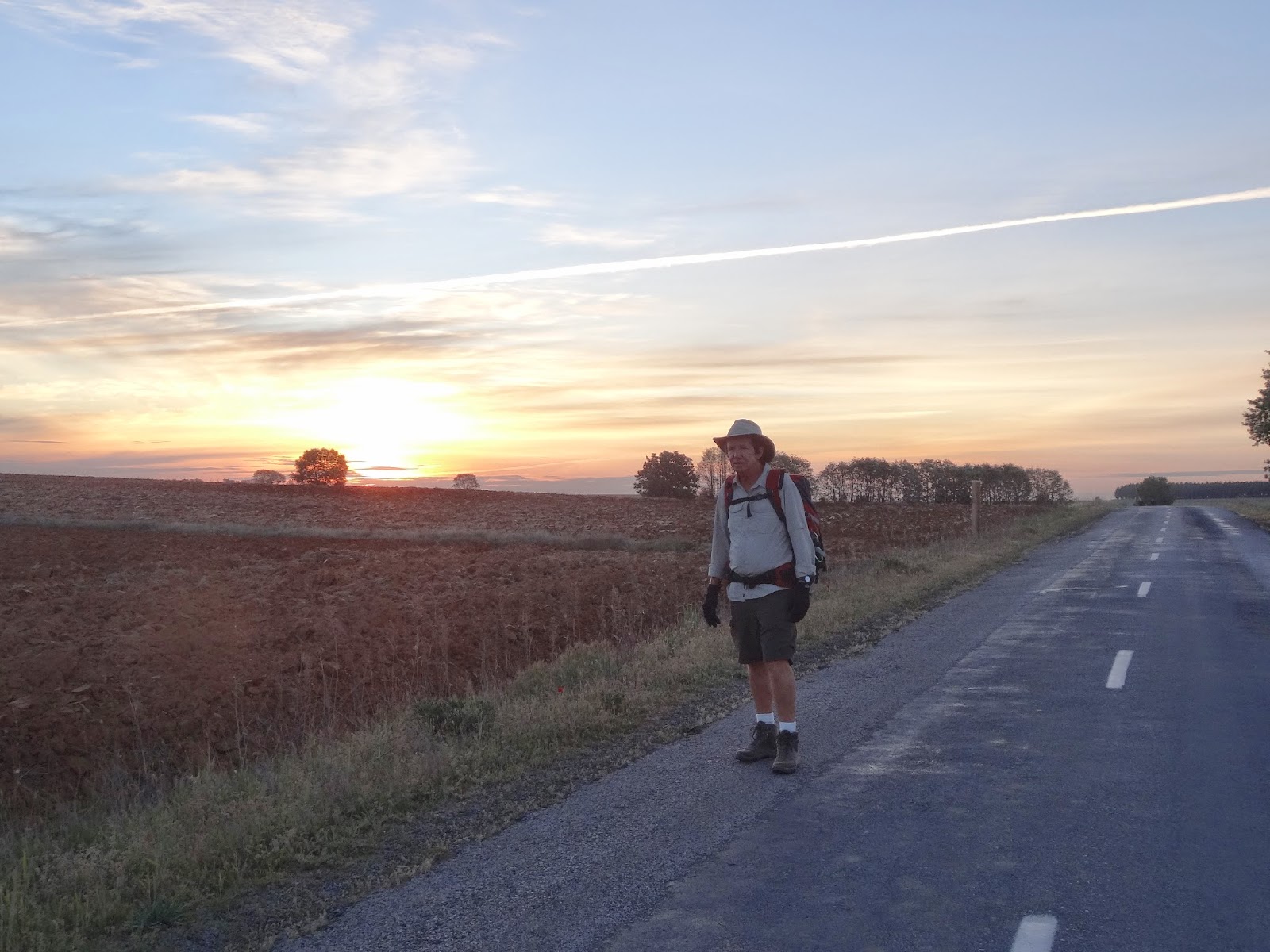
Today the walk was even better as the bitumen road out of town gave way to a gravel road and before long turned into a good gravel track.  Yesterday we walked towards the snow capped mountains, but today we walked between them.  For the last two mornings we have set out early, at dawn, around 6:30 am, and walked for several kilometres before eating breakfast in the first village we came across.  Although cold, we soon warm up as the sun rises behind us.  This morning was particularly lovely as a full moon was still visable in the dawn sky.

Breakfast usually consists of a slice of tortilla, an egg and potato quiche type of dish (very tasty, but it does get boring) coffee for Steve, fresh squeezed orange juice for me, accompanied by a few slices of the ever present but delicious sliced barguette type bread.  Very occassionally we are able to get an omlette, but not often, so even though breakfast is tasty and nourishing, we have been eating almost the same thing for a month.

Today we walked 22km, gently climbing all the way to Robanal del Camino, a lovely hillside village with a population of 50.  The town however can accommodate up to 200 pilgrims in various forms of accommodation, ranging from the church run alburgues to an up market hotel.  This town would not survive without the patronage of the pilgrims on their way to Santiago.


Tuesday, 13 May 2014

Day 24

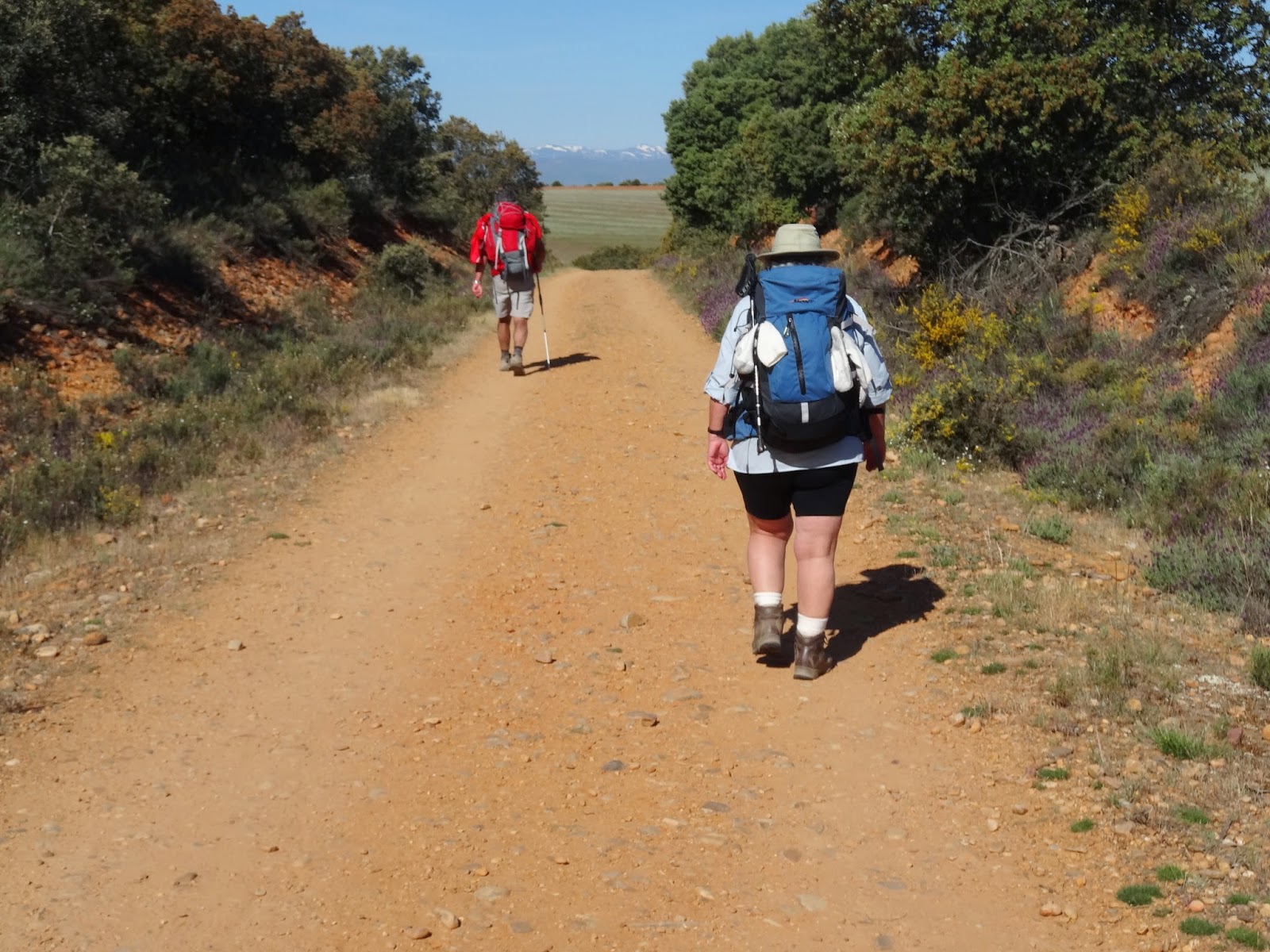
Yesterday we caught a taxi to the outskirts of Leon and hit the trail again, it was great to be back walking in the countryside. Many pilgrims take this option to avoid the unpleasant walk through busy city streets and industrial areas. People we have spoken to who did walk out of Leon said they wished they hadn't and in hindsight should have taken the bus or taxi.  John Brierley's guide book even recommends this option.

We've had two relatively short walking days of about 17km each with another one coming up tomorrow.  The John Brierley guide book breaks the walk up into sections which can be up to 36km long, too far for us to walk in a day, therefore we sometimes take two days to complete a section.  At this stage of the Camino, villages are not as frequent as the earlier stages, therefore we need to plan the days walk and overnight accommodation around this.  For instance we would prefer to walk 20km per day, however if there is a village at 17km and no other village for another 13km, then we must stay in the first village, as 30km is too far for us to walk in one stretch.

Many people attempt to follow this guide religiously, however we find it more enjoyable to do shorter days allowing time to rest and investigate things along the way.  We are seeing many walking wounded pilgrims at this stage, most have blisters, some severe, and I can only surmise that the reason our feet are still in relative good shape is due to the fact that we are walking the shorter daily distances.  

Another factor that has saved our feet is due to less weight in our packs.  Several days ago, in Sahagun, a town prior to the worst section of the Roman road, we posted some of our gear on to Santiago.  We had used our sleeping bags only twice and we were well over half way, so decided they could go.  Also one set of clothes each, we've found two sets to be sufficient, as well as our lightweight fold up umbrellas (what were we thinking when we packed those, although they were very handy in Paris).  Altogether we lost approximately 1.8kg each.  That may not sound like much but it's certainly noticeable after a long days walk.

Last night we stayed in an alburgue, albiet in a private room with bathroom, in the town of Vilar de Mazarife.  On the outside wall of this building was a plaque that read 296km to Santiago, which means we are almost two thirds of the way there!  Yeah!

Today the weather has turned cool and snow capped mountains again came into view on the horizon. We are in the village of Hospital de Orbigo which has one of the longest and best preserved medieval bridges in Spain, dating from the 13th century, an amazing sight as it came into view as we entered town.

Tomorrow we walk to Astorga, finally leaving behind the flat terrain of the Meseta.  After more than a week of walking on roads; bitumen, gravel and Roman, we're hoping the trail becomes more track like as we head towards Montes de Leon, where we will reach the highest point of our treck.  Challenging days ahead!


Sunday, 11 May 2014

the Meseta

We are in the lovely city of Leon, in a four star hotel, enjoying two days rest and recreation before setting out on the Camino again tomorrow.  

We've just spent 7 days walking across the Meseta.  We enjoyed the first four days, pleasant walking through the gently rolling hilled landscape of lush green wheat fields.  The weather was warm and the sky clear blue. The last three days however, where very different to that.

For 60km we have walked what is known as the old Roman road, dead flat, dead straight, hot and rocky, very rocky, with rocks as large as a closed fist, making walking not only difficult but painful.  We still don't have blisters, but our feet felt battered and bruised.

Most pilgrims take an alternative route, a track which is a fraction shorter and runs adjacent to a busy, noisy main road into Leon.  We decided to take the original Camino route, although perhaps that was not the best decision.  Yesterday was our third day of walking the old Roman road and as we hobbled into the uninspiring town of Reliegos, decided not to spend the night there and instead caught a taxi for the last leg into Leon.

We of course had no accommodation booked for Leon as we arrived a day earlier than planned.  On arrival we went straight to the visitor information office for a city map whith a list of all hotels in the city centre and began phoning around in search of a room for two nights.  We began by phoning the two star hotels, however all were fully booked or 'complete' as they say in Spain. We then moved on to the three star hotels, all were 'complete'. From there it was a choice between the one star or the four star hotels.  We were tired, our feet hurt and we were desperate for a room, so the four star was the one we called. It was a good decision, and I woke up in a lovely comfy bed on Mothers' Day.  We found out later the reason for Leon being so busy this weekend, the city marathon was held this morning.

Leon is the third city on the Camino.  First was Pamplona, second Burgos, now Leon.  Pamplona, where they hold the running of the bulls, although a nice city, felt busy and bustling.  Burgos, our favourite, was full of beautiful architecture, lovely streets to walk through and the most magnificient cathederal we have ever seen.  Leon comes a close second with interesting streets and architecture as well as an amazing cathederal.

The cathederal here has 1600 square metres of stained glass which is breathtakingly beautiful.  Some windows are quite unique in that they contain panels of plants and flowers instead of religious or biblical figures.  The church also houses priceless ancient artwork and sculptures.  One I particularly admired was a 13th centuary stone statue of a very pregnant Mary, quite beautiful and unusual, as I cannot ever recall seeing her depicted in this way.  We are more than happy to pay the entry fees charged to help maintain and preserve these incridible gothic architectual wonders.  It has just taken four years to clean and restore the stained glass windows.


Tuesday, 6 May 2014

Wildlife on the Camino

We had read that there was not much wildlife to be found on the Camino and to an extent that is true, however we have been presently surprised by the amount of birdlife we have seen or heard each day.

A day hasn't passed where we haven't heard a Cuckoo and almost every village has Storks nesting on the church steeple.  Ten days ago when we were trudging along a muddy track in cold drizzling rain between Los Arcos and Viana, I was lagging a bit behind the others when two beautiful birds appeared beside me on the roadside.  They were black, white and yellow, similar to our New holland honeyeater in Australia.  They flew from side to side across the track just in front of me for about 50 metres, stopping occasionally to perch on a rock or shrub to trill and sing, as if encouraging me to push on. 

Today we walked 21km from Boadilla Del Camino to Villalcazar de Sirga, which included a lovely 10km stretch walking beside the Rio Ucieza.  The river bank was treed and we walked to the sound of croaking frogs and birdsong all the way.  We spotted a really lovely bird in the rushes which we later identified from a bird guide notice board as a Pito real.  From this board we were able to identify some of the other birds we had seen such as the pretty yellow breasted Carbonera comun and the cute little black and white Agateador comun.  Even when walking along the flat streches of the Meseta where lush green wheat fields stretch to the horizon, with barely a tree to be seen, birds can be heard but rarely sighted as they go about their business amongst the crop.

Apart from birds, wildlife sightings had been almost non existant, until yesterday when we spotted an amazing bright green lizard run across the road in front of us then into a ditch on the side of the road.  He stayed long enough for us to get a really good look and a photo before disappearing into a burrow in the embankment.

As for domestic animals, we had read that pilgrims should be wary of unrestrained, vicious farm dogs, however we have encountered none.  All dogs in the towns and villages have been on a lead, and all the farm dogs we have come across have either been tied up or in a kennel, all seemed pretty friendly, and every village has several resident cats.  A few days ago we came across a farmer driving a herd of sheep along the road with the help of several sheep dogs.  It was quite a large herd of a hundred or more and we had to stand on the edge of the road as all the sheep walked closely around us.  It was great to watch the dogs working the sheep, moving them forward whilst keeping them from straying.  Many sheep had bells on and it took several minutes for them to pass.  This was just the sort of rural  Spain we had hoped to see.

Apart from perigrinos on foot and perigrinos on bicycles, there are a few perigrinos travelling with donkeys.  We have seen three sets so far.  Apparently the donkeys can be hired and then collected at the end of tne trek, a bit like a hire car.  The donkeys are not generally ridden but used as pack animals, although we did encounter a family where mum and dad were walking and their little girl rode on the donkey in a saddle.


Sunday, 4 May 2014

Day 15

Yesterday morning we said our goodbyes to Anita and set out early through the deserted streets of Burgos. We walked 20km to the village of Hornillos del Camino. It was a cold day but sunny, with a clear blue sky, perfect walking conditions. It felt great to be back on the Camino, walking was pleasant, mostly on good gravel surface, not too much on bitumen roadway, gentle inclines and interesting countryside.

There are more pilgrims than expected walking the Camino at this time of year, plus many Spanish have taken to the Camino over this 4 day holiday period, making accommodation scarce in these small villages. For this reason we have started to book accommodation one or two days ahead to avoid the problem of searching for a room at the end of a days walk when feeling foot sore and weary. Of course it is nearly always possible to obtain a bed in an alburge if we are desperate

Accommodation at Hornillos del Camino was booked out so we arranged to stay at the Casa Rural el Molino, situated, we were told, just a few km outside the village. When we arrived a little bus came to collect us and drove for at least 10km out into the countryside. We had absolutely no idea where we were going and the driver spoke no English. We eventually arrived at a large, sprawlling Spanish house and shown to our accommodation at the rear. We entered through a doorway into the dining / lounge area and sitting at the table was a fellow pilgrim, Diane from Seattle, whom we met at the start of the walk and keep running into along the way. We just couldn't believe that out here in the middle of nowhere we would find the friendly face of someone we knew. It was another weird and wonderful Camino moment. Although only early afternoon, it was freezing cold outside, so we lit the wood fire, ordered a bottle of vino tinto, put our feet up, settled in, then talked and laughed away the remains of the day.

On the walls we noticed posters for the movie 'The Way' signed by Martin Sheen and Emillio Estevez, as well as a lovely framed black and white photograph of Martin Sheen and his co-stars standing in a line with their packs on, which was from a scene in the movie. In broken English and Spanish we ascertained that the picture was taken in the adjacent field and that Martin Sheen and Co had stayed here whilst filming.

That evening we had a delicious meal of tomatoes in dressing, boiled eggs in a white sauce, garlic soup, ham, cheese, roast beef slices in gravy, and a black type of sausage stuffed with rice and vegetables, followed by an ice cream desert.  Nice change from the usual pilgrims menu.  After an early morning breakfast of coffee and toast we were driven back into the village to continue walking. The accommodation, meals, wine and transport cost 78 euros, great value.

Todays 22km walk was similar to yesterday, great weather, good track, lovely countryside, with the added bonus of meeting up again with our new Aussie friends from Townsville.  We have now entered the rellative wilderness of the Mesata which we find quite lovely, so far anyway, and not as flat and featureless as we had been led to believe.  As usual, there was history in every village and out along the road we walked under the archway of the11th century San Anton fortress.

In a couple of days we estimate we will reach the half way mark, hard to believe we have made it this far unscathed and enjoying it all so much.


Friday, 2 May 2014

Three Amigos

We are all in Burgos, however tomorrow the Three Amigos will become just two.  Early tomorrow morning Steve and I will set off on the Camino and walk to Hornillos del Camino, while Anita boards a bus to Madrid to connect with her flight home to Australia.

It will be a sad farewell and a different Camino without Anita.  We have had an amazing journey together, good times, hard times and moments to treasure.

This is our second day in Burgos, a lovely city with arguably the most magnificient cathederal in Spain.  We were not supposed ro arrive here for another two days however, unknown to us, yesterday was a public holiday in Spain, similar to our Labour Day in Australia, and apparently the festvities last for three days in this region.  This led to a shortage of accommodation in the small villages we were to pass through and every hotel or pension we contacted was booked out.  It was for this reason that the hard decision was made to break the journey and catch a bus to Burgos, thus forfeiting 50km of this section of the walk.

We have enjoyed our stay here with lovely streets to walk through,  spent a couple of hours in the cathederal, and our feet are well rested.  We tasted tapas for the first time and loved every mouthful, stuffed peppers, plates of mushrooms and artichokes, I'll definitely be on the lookout for a good tapas coobook when I get home. As lovely as it is, Burgos is a city, and we're really looking forward to getting back out into the Spanish countryside and back on the Camino.


Wednesday, 30 April 2014

Day 10

This is day 10, hard to believe.  We have walked about 230 km. Two days ago we were in Najara, not a great town, a bit jaded, but as usual the Camino surprised us again. It was a public holiday and festival day in Najara, with everyone out in their best clothes for a religous procession with a  celebration of wine and food afterwards. We went into the lovely old church and on my way out an old lady took me by the hand and walked up the aisle talking to me in Spanish the whole time and although I told her I did not 'comprende', she just continued talking to me seriously and would not let me go until we reached the door where upon she smiled and wished me a buen camino.

Yesterday we deviated off the camino and walked to the monastery town of Canas to visit the Cistercian Abbey of Santa Maria, a magnificient 11th century building where nuns still reside.  It houses one of the finest sarcophagi in Spain.  This detour required walking on bitumen roads for the entire day.

Yesterday was also the first day we have missed a yellow arrow or shell marker and become lost.  We ended up on an isolated road winding through farmland and had to flag down a farmer in a tractor for help with directions.  We have found the Spanish people to be so friendly and helpful and really go out of their way to help perigrinos.

Today we are in the town of Belorado.  On our way here we passed through the town of Santo Domingo de Calzada where we paid money to climb the 70 metre bell tower of the magnificient 12th century cathederal, which is unique in that it houses a rooster and hen inside the church in a special cathederal coop. This coop relates to the story of 'the Miracle of the Cock'.

We are having the most amazing time.  We have put in a few big days, the biggest walk was 25km and boy did our feet know about it.  The track varies from cement and bitumen through the towns to dirt roads, sometimes muddy, good gravel tracks, the best to walk on, to rough stoney pathways which are real torture on the feet. We all have tired aching feet now and are planning to have a rest day in Burgos in a few days time.

The churches here are incredible and the local people have a very strong Catholic faith.  In the larger villages the church is open every evening and they celebrate mass, sometimes a pilgrims mass. We attended one and it was really lovely.  Spanish chuches are so different due to the baroque decorations and artwork inside, lots of gold and statues, a bit gaudy really, but still amazing.

The temperature is still quite cool.  It's very cold some days and we have walked for several hours in very cold drizzling rain on two ocasions.  Other days have been sunny with clear blue skies and warm afternoons.  There are still traces of snow on the higher distant mountains.

Sometimes the food  is a bit dissappointing. They put on these set pilgrim menues so you have to take what is on offer which is not always great. They can do amazing things with eggs though, omlettes, tortillas, and the bread is also amazing, baguettes just like in France.  Eggs, bread, ham, cheese, and a good choice of fruit are the stable for breakfast and lunch.  We get up at 6am and get going by around 7am and try to walk for several km before reaching a village where we have coffee, eggs and bread.  We then eat some fruit along the way, then buy a ham and cheese baguette for lunch.  (The ham products here are amazing, like in France).